One of the hardest things in government is getting people to buy into the idea that sometimes you have to spend tax money on something now to save more in the long run.
Hence, it can be a tough sell to argue that by investing in early childhood education you’ll have fewer high-risk youths heading for much more expensive prisons later, as a law enforcement group argues here.
Saving tax money over the long term is also a good reason to support preserving farmland. Before the housing slump, open space was disappearing from the Lehigh Valley at the rate of four square miles a year and will no doubt pick up again as the housing market returns.
“If that 100 acres turns into a housing development, that 100 acres is going to cost the community a lot more than if you keep the 100 acres as a farm,” said Jeff Zehr, director of farmland preservation for Lehigh County. With housing subdivisions comes the need for more public services such as road maintenance, police, snowplowing and, the most expensive, schools.
“I always like to say cows don’t go to school,” Zehr said.
By the time you read this, Lehigh County commissioners should have voted on a budget that allots $200,000 for farmland preservation.
That money can be parlayed with matching state funds, which altogether could mean about $1 million in 2013 to keep local farms from being paved over in favor of the latest townhouse development or strip mall.
The way it works is county representatives assess what the farm would be worth if the land was developed and what it is worth as a farm. The difference is what the county pays the farmer for the development rights. Lehigh County caps the price at $5,000 an acre but Northampton County has no cap.
Each farm seeking to sell its development rights is assessed on several criteria, including quality of the soil, location and size, and given a score. The better the score, the higher it is on the waiting list.
“If a farm came in from Lower Macungie Township that has beautiful limestone soil, that would probably rise to the top of the list,” Zehr said. “We just don’t get many applications from Lower Macungie and part of it is because the land values are so high there.”
Currently, there is a 37-acre farm along Weiss Road in Upper Macungie that is seventh on the list.
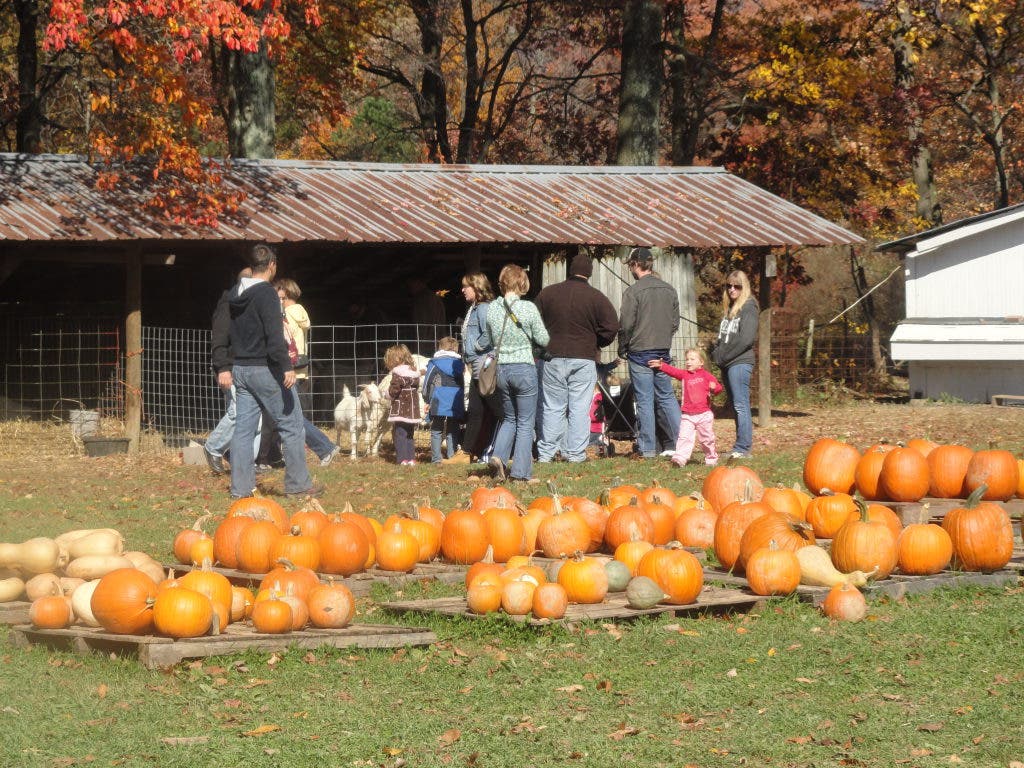
After a glorious day Sunday at the Lehigh County Open Gate Farms Tour, I asked Zehr how preservation efforts are going. He said as of Wednesday, the county has preserved 249 farms for a total of 20,628 acres. About 70 farms are on the county’s waiting list.
To date, Northampton County has 12,099 acres preserved on 118 farms and a backlog of 30 farms that the county expects to be able to preserve with $6.18 million in 2012 funds.
Keeping land in farming is smart, not just because it keeps taxes down but also because it’s important to have locally grown sources of food, Zehr said. Farms are good habitat for some wildlife and essential to the character of the Lehigh Valley.
But you can’t have local farms without local farmers and the average age of farmers in Lehigh County is 57, he said. “I think there’s three times as many farmers over the age of 70 as under the age of 35 in Lehigh County.”
Enter The Seed Farm. Located in Upper Milford, The Seed Farm is an agricultural-type business incubator designed to teach people how to farm.
Lehigh County and the Penn State Cooperative Extension collaborate with The Seed Farm, a nonprofit near Vera Cruz to run the program.
“Basically, we’re growing new farmers,” Zehr said.
So Zehr is right -- cows don’t go to school but thank goodness fledgling farmers can.
Ron - Chairperson
Lower Macungie Township, if it is serious about preserving open space and farmland, needs to explore creating a program to buy development rights. Transferring development rights, or buying the land outright, is the only effective way to truly preserve land and the fairest mechanism for landowners. There are certain necessary assumptions about preserving land. If the public is not willing to accept these assumptions, no land can be permanently preserved. 1. Open space and farmland serves the greater good and is a benefit to society. 2. Despite the fact that survey after survey supports this and shows that the community values open space and farmland unfortunately, the free marketplace assigns little value to open space and limited value to farmland. 3. Because of this, open space and farmland will eventually be developed in an area where economic development demand is strong. 4. Open space and agricultural zoning is temporary and some argue unfair to the property owner who must bear the burden for the sake of the community. Open space and agricultural zoning also gives a false sense of preservation. 5. A community must be willing to enter the marketplace to preserve open space and farmland. Failure to do so will result in all developable land eventually being developed.
Based on the above assumption that purchasing development rights is the only permanent and yes, fairest mechanism for landowners. And based on the fact zoning can be changed as it was here in LMT opening the door for 700 acres of farmland to be paved and built up with warehouses, strip centers and housing.... We support: The reforming of a permanent township Farmland and Open Space Preservation board that reports to the planning and zoning committee. This committee would be responsible for the following: -Exploring and advocating for mechanisms the township can use to purchase development rights. -Making Recommendations to the Board of Commissioners -Setting priorities for land acquisitions.
Voters see the connection between growing in an inefficient sprawling way and the expensive drains on our schools and infrastructure. At it's core smart growth and land preservation is a fiscally conservative policy. Voters get it.
Unfortunately state law prohibits a school district from buying land to prevent its use for housing developments, although what Margie says is obviously right:. Housing developments are a disaster for school districts. They do not provide enough taxes to educate the students who live there. While I was on the Board of the SVSD we tried to buy the land across the street for future use of the school for either building new school buildings or new athletic fields. We attempted to obtain the land by eminent domain and, to that end, issued bonds for Three Million dollars at a very low interest rate because the districts financial condition was then excellent. After I left the board, the board decided not to proceed with eminent domain (one of the directors thought eminent domain violated the Constitution and the Declaration of Independence, which, or course neither do.) Now the board is using the loan money, which must be spent on capital projects, to refurbish the football Stadium! Somehow, you can't win.
This isn't much per residents but could save hundreds of acres. We really don't have much more farmland left in LMT. But the money used potentially to preserve vs. the potential future permanent taxes needed to support more development on these tracts (school, local, state ect).... really it's an investment. We have to start thinking this way.
Seven townships in Northampton County have approved a .25% Earned Income Tax to be used specifically for Open Space. The County has successfully partnered with 4 of them to preserved farmland in those communities. Bushkill Township has preserved two farms on their own. We have proven it can be done, with committment, dedication, funding, and now support from the tax payers, we can make great strides to preserve open space and farmland for generations yet to come. Maria Bentzoni, Administrator, Northampton County Farmland Preservation
I am proud of the fact that with the help of Lehigh county, and Upper Milford township we were able to preserve forever the Schantz farm a great large farm in our township. If you read our Open Space plan on line at upper Milford there is a section where it tells you the benefits of preserving farmland rather than developing it. the $$$$ amounts are staggering when you cost them out over 20 years.
FYI, Lehigh County has drastically cut farmland preservation funding over the past few years after spending generously for years before that. Lehigh used to give $1 million a year and more and now it can barely afford $200,000, which does not leverage much matching money from the state. Meanwhile, Northampton County, which was a laggard compared to Lehigh for the first 15 years of the farmland preservation program, is now spending big time on preservation. Good for them